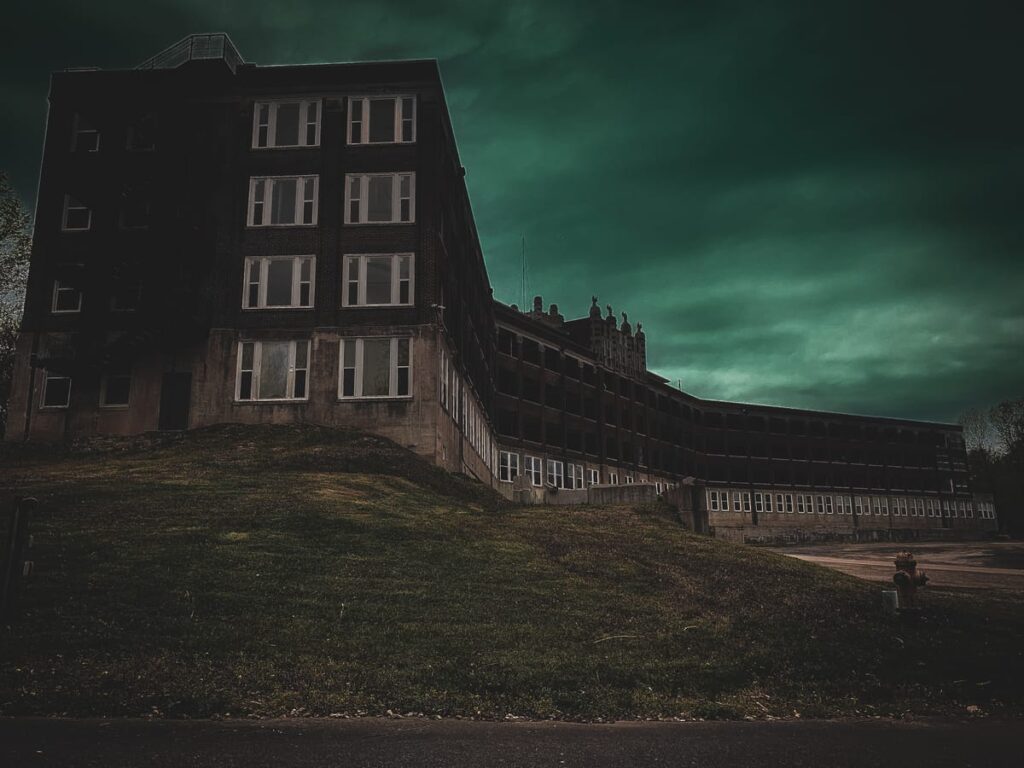
Washington Opera House
Born from fire, Washington Opera House may have a few spirits baked into its foundation
Paranormal Activity at Washington Opera House
- The theater is said to be haunted by a ghost named Loretta
- Disembodied voices are commonly reported throughout the building
- Objects are known to be moved without explanation
- There are stories of theater lights falling from their rigging, with blame falling on Loretta's ghost
- Loretta's spirit is also said to catch falling objects and provide tools to workers when requested
Washington Opera House: Inside Kentucky’s Most Haunted Historic Theater
When one thinks about the history of theater, Broadway often comes to mind. But one other place has a theatrical history that reaches as far back as Broadway’s: Mason County, Kentucky. Once home to the first theatrical performance west of the Appalachian Mountains, Mason County remains steeped in performance history thanks to one landmark: the Washington Opera House.

The opulent Washington Opera House has hosted many traveling troupes and local theater guilds over its long history. In that time, the theater has gained a secondary reputation as a place where the ghosts of past performers still seek their moment in the limelight.
Timeline of Washington Opera House's History
Swipe or use timeline points to see Washington Opera House through the years

1800
The first theatrical performance in Mason County was in 1797, when a show was hosted at the county courthouse. By the early 1800s, theater shows had become a common occurrence in the area. They were soon a cultural cornerstone of the communities in Mason County.
It wasn’t long before the high demand for performances required a new theater. Luckily for some, and unluckily for others, the opportunity to construct a community theater would soon arise.

1850
In April, 1850, a massive fire spread through Maysville. Most of the West 2nd Street block, including a large church known as the Old Blue Church, was destroyed. In the aftermath, new fire stations were built on much of the Old Blue Church’s former site.
The plot of land that was left over was dedicated to a brand new performance venue. Work on the theater started soon after.

1851
The expansive new theater opened in 1851 and quickly became a cultural staple of Maysville. Regular shows shared the stage with school commencements, patriotic meetings, and political debates. For over forty years, Maysville’s theater was a hub of activity.
Alas, the theater was destined to go out the same way the Old Blue Church did. A devastating fire gutted the theater in 1898, even with the local fire stations right next door.

1899
Fire crews themselves helped fundraise for a new theater. A year after the destructive blaze, a replacement venue opened on the previous site: Washington Opera House. Following its grand 1899 opening, the spacious theater met with countless famous performers of the 20th century. Washington’s stage greeted Tom Mix, John Philip Sousa, and many traveling Broadway shows.
But, by the end of the 1950s, the allure of films and television cut deeply into Washington’s business.

1960
A theater troupe, the Maysville Players, formed in 1962 and began fundraising to purchase the ailing opera house. The troupe ultimately succeeded, and by the early 1970s were bringing the venue back to its historic splendor. Still today, over half a century later, the Maysville Players remain dedicated stewards of the Washington Opera House. The troupe manages show schedules and books regular acts.
Though, perhaps most importantly, the troupe also manages the opera house’s resident ghost.
Is the Washington Opera House Haunted?
The Washington Opera House’s ghost legend begins with the name Loretta Stambo. The most popular tale is that Loretta was once a performer in the original theater who, despite being ill with pneumonia, took the stage anyway. She is said to have collapsed during her performance and either died in her dressing room or at a nearby hospital. On her death bed, she requested to be buried under the opera house’s stage.


It is unknown whether this wish was granted, and the 1898 fire made confirmation of the legend all the more difficult. Loretta herself may have been a Maysville myth, though a woman named Laura Stambo was recorded as having lived in Maysville around that era. So, the reported spirit could be Loretta, Laura, or even a mysterious unnamed entity. But no matter who she truly is, many people have encountered her at the Washington Opera House over the years.

Loretta Stambo, Washington Opera House’s Resident Ghost
Loretta’s ghost manifests in a variety of ways. Visitors frequently hear disembodied voices from far away in the theater, only to investigate and find nobody around. Others claim her spirit will move objects and even throw some things that she doesn’t like. One story says that Loretta was the cause of a light falling onto the stage while a group of performers were meeting there. Another event blamed on Loretta’s spirit happened when a soda bottle inexplicably exploded while sitting on a table. Apparently, Loretta didn’t like that kind of clutter in her space.

Flickering Lights, Exploding Bottles: Inside Loretta’s Ghostly Antics
Despite some ghostly mischief, Loretta Stambo’s spirit is also said to be quite helpful. She will catch falling objects and deliver requested tools to workers when asked. And though the Washington Opera House isn’t a regular stop for paranormal investigators, some visit the theater looking for Loretta’s ghost. These ghost hunters sometimes come away with files of audio anomalies and potential EVPs recorded around the theater.

Why the Washington Opera House’s Ghost Story Refuses to Die
Over a century of time, and a history of unfortunate destruction, the Washington Opera House has shown its life is not so easily snuffed out. And the lives of its most adamant supporters and passionate performers may not be so easily snuffed out either. That is, if the legend of Loretta is to be believed.
Live shows understandably take center stage at the Washington Opera House, leaving ghost stories by the wayside. But, the theater has hosted ghost hunts in the past, and sometimes explores its ghostly lore with related programs. Ghosts and old theaters just go hand in hand, and the Washington Opera House is a perfect example. If Loretta’s ghost story is any indication, neither sickness, death, nor fire will keep her away from her treasured venue.