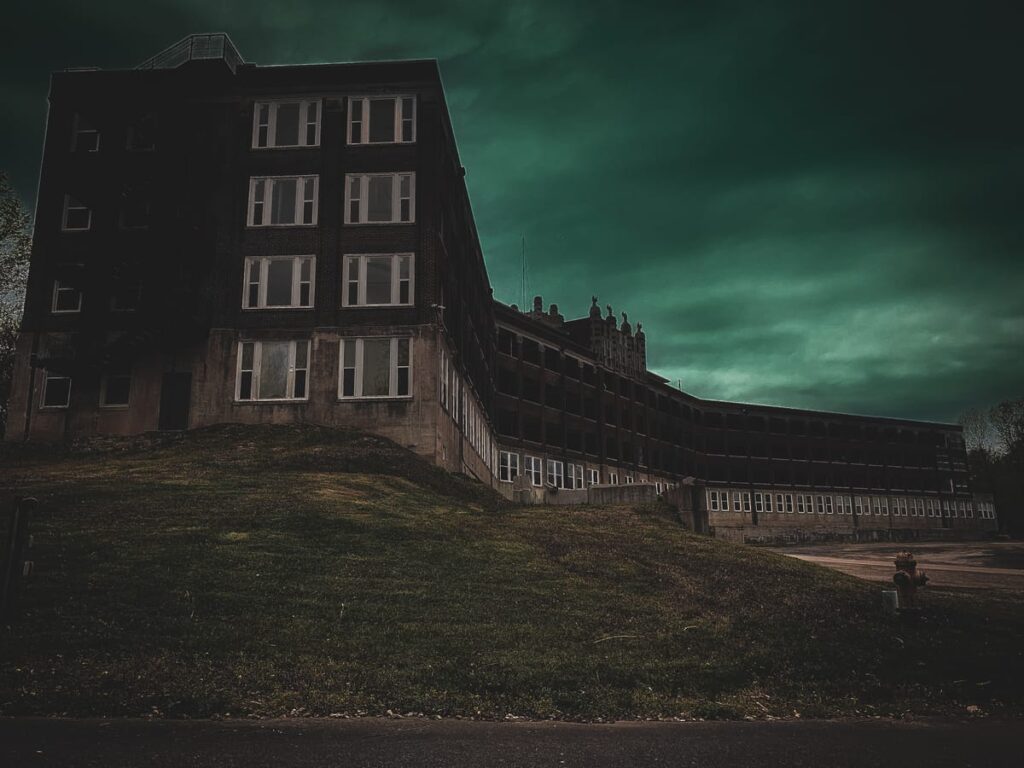
Conrad-Caldwell House Museum
Wander off from your tour at this historic museum, and the ghosts might scold you themselves
Paranormal Reports at
Conrad-Caldwell House
- Visitors and staff report sounds of footsteps and canes on upper floors
- A ‘short’ apparition scolds visitors who wander
- Doors and cabinets open and close by themselves
- Motion sensors trigger on the main staircase
- An apparition manifests near the butler’s pantry
- Small items will move around rooms
- Unexplained uneasy feelings are reported in the basement
- Disembodied voices are reported throughout the house
- Lights are turned on and off by unknown forces
- Scents of cigar smoke waft through the mansion’s air
A Gilded Age Treasure:
History of Conrad-Caldwell House
From gaslit sidewalks to expansive Gilded Age mansions, the St. James Court neighborhood of Louisville, Kentucky, thrives like the 1890s never ended.
And wherever time stands still, history’s hauntings flourish.


St. James Court’s most well known haunted house is a broad, looming form on its historic block: the Conrad-Caldwell House.
As a public museum, Conrad-Caldwell House preserves its history through exhibits spread throughout the home. And, for every distinct era of its past, the mansion claims a ghost or two…or three.
Timeline of Conrad-Caldwell House Museum's History
Swipe or use timeline points to see Conrad-Caldwell House Museum through the years

1890
Conrad-Caldwell House was one of the first mansions built on St. James Court. The massive residence was the vision of successful local leather tanner Theophilus Conrad. Conrad wanted the grandest private retirement home in Louisville’s newest neighborhood. Designs were first discussed in 1890, but it took five years to plan and build. Once the Conrad family moved into the spacious manor in 1895, they quickly became fixtures of St. James Court. While Theophilus delved into retirement, his family helped turn the house into a home.

1905
From inside his mansion, Theophilus Conrad and his family watched the rest of St. James Court take shape through the 1890s and into the 1900s. More mansions sprouted up, and the area soon bustled with Louisville’s rich and powerful. But, the Conrad’s time in the home would come to a sudden end. In 1905, while preparing the basement furnace for a blizzard, Theophilus suffered a heart attack. As no doctors could brave the snow in time, he died in an upstairs bedroom.

1906
In 1906, the Conrad family sold their mansion to family friends, the Caldwells. William Caldwell made a fortune as the head of the Caldwell Tank company and had long been interested in Conrad’s spacious castle. William quickly moved his wife and two children into the manor, and the family spent the next four decades growing old in its stone walls. By the mid-1940s, the huge house no longer suited the Caldwells’ needs. Rather than sell it, the family donated it to the Presbyterian church for use as a widow’s home.

1947
Conrad-Caldwell House reopened as a widow’s home in 1947. In no time, dozens of elderly Presbyterian women filled the home’s wide open spaces. While originally restricted to just Presbyterians, the home opened their doors to all widows a few years later. Through the 1950s, 60s, and 70s, the widow’s home’s operators covered and replaced many of the mansion’s more opulent features, while still keeping it comfortable for all of the residents.

1987
In 1987, new owners arrived at Conrad-Caldwell. The St. James Court Association purchased the home for restoration. They hoped to open the house as a public museum, receiving a groundswell of support to make that happen. The Conrad-Caldwell House opened as a museum shortly thereafter. Restoration work continues today, as does preservation of the home’s many artifacts. But while museum staff carefully curate the rooms, ghostly Conrads and phantom Caldwells may still be living their lives right beside them.

Is Conrad-Caldwell House Haunted?
Conrad-Caldwell House is purportedly home to many spirits, but few are as active as Theophilus Conrad. He had the mansion built to be his retirement home, drew his last breath in its walls, and now seems to conjure new ghostly activity every day. In life, Theophilus had a noticeable limp from a Civil War injury and walked with a cane.
Today, museum staff can hear his limping footsteps and stamping cane coming from the third floor. But, whenever they go searching for ole’ Theo, he’s nowhere to be found.

Billiard Room Wraiths
Around the home’s old billiards room, visitors and staff alike report scents of cigar smoke, even though the museum has been smoke-free since it opened. Many now figure the smoke is from Theophilus, just enjoying a relaxing and eternal retirement.
Whether he’s roaming around or relaxing with a cigar, Theophilus doesn’t often stop and talk to visitors. That is, unless they start a conversation in French. His specter is known to get especially active whenever a fellow Francophile tries to connect with him.
The Museum’s Spooky Short Stories
Theophilus’s brand of paranormal activity, and his usual hotspots, make him easy for museum staff to track. Sometimes, he even appears right in front of tourists.
Visitors frequently report a man matching Theophilus’s portraits wandering the home or lingering on an inaccessible balcony.


In one well-known report, a tourist sauntered away from their guide and came face-to-face with Theophilus, who wagged a finger at them before disappearing.
This tale, and others like it, refer to Theophilus Conrad as a remarkably small man, though history proves this to be an exaggeration. Some reports swear he doesn’t even crack five feet tall, but historic documents list him as 5’7”.

Basement Spirits at
Conrad-Caldwell House Museum
Theophilus’s activity upstairs is remarkable enough on its own, but his entity may also linger below ground. Down in the basement, near the old furnace where his deadly heart attack began, tourists report unexplainable feelings. It’s not uncommon to get strange vibes from old, dark basements, but the claims from beneath Conrad-Caldwell House are especially eerie.
Sensations of being closely watched and uncertain feelings of dread come over some basement explorers. But, these feelings fade once the explorers get back to the first floor.
The Eerie Elaine Caldwell
While Conrad-Caldwell House’s most active ghost might be Theophilus, he’s far from the only haunting there. William Caldwell’s wife, Elaine, is another reported specter.
Her spirit is encountered in her old bedroom on the second floor. There, the soft voice of a woman sometimes breaks the museum’s quiet air.


While she will often try to speak, Elaine is selective about who she talks to. She will only ever try to speak with women when they’re in her room. Men get the silent treatment, and at times, an off-putting feeling.
Whenever she’s not talking to visitors in her room, Elaine purportedly takes walks, with her light footsteps tapping down the home’s main staircase.

Widows Still Linger Within
Not far from Elaine’s second floor bedroom is another haunted hotspot. A sitting room, often used during the widow’s home era, is reportedly still home to a few Presbyterian ladies. The ghostly widows don’t wander far or speak to many guests. Instead, they’ll play little tricks and pranks to let staff and visitors know that they’re there.
Lights in the sitting room will flip on and off by themselves, and door knobs to the room will rattle whenever people are nearby. The playful widows may also move small items around the room just to trick staff, who carefully set up the room’s exhibits.

Spectral Servants Stay Busy
Conrad-Caldwell House has no shortage of established entities. But the haunted Louisville mansion also has some unknown spirits. A man’s apparition, not fitting Theophilus’s description, is sometimes spotted on the first floor. At least one staff member has seen this mysterious man near the butler’s pantry.
Along with the mysterious butler, other servant specters may roam through. Hurried, busy footsteps are heard throughout the house. In certain rooms, doors and cabinets will suddenly swing open and closed. Perhaps the spirits are just trying to help keep the house in order.

Ghost Hunts at
Conrad-Caldwell House Museum
Conrad-Caldwell House doesn’t often open its doors to ghost hunters, but that has changed in recent years. Through a few ghost-centered tours and investigations, even more activity has been uncovered. Visiting ghost hunters report hearing disembodied voices and capturing potential EVPs.
Additionally, Spirit Boxes and other ITC tools produce seemingly intelligent responses to questions. More than just capturing potential spirit voices, investigators have validated other claims around the house as well. Elaine’s footsteps on the stairs are often picked up by motion sensors used during investigations.
Conrad-Caldwell House:
St. James Court’s Most Haunted
For generations of Louisville locals, a house on St. James Court was the pinnacle of the American Dream. A distant, but still possible goal that could display all the wealth and success found in one’s life. Over the years, few families ever achieved that dream.
But those who didn’t could still enjoy the splendor of success, as imagined by Theophilus Conrad, through a tour of the Conrad-Caldwell House.

Historic tours are still popular at the mansion today. And while ghost tours aren’t regular offerings right now, museum staff are exploring more ways to incorporate the home’s hauntings into its story. Only one house in Old Louisville can call itself the area’s most haunted. And it just so happens to be the Conrad-Caldwell House, the crown jewel of St. James Court.
Whether it’s the light of the gas lamps, the sights of Gilded Age mansions, or the lingering spirit of Theophilus Conrad, there’s just something about the neighborhood that keeps history alive.